

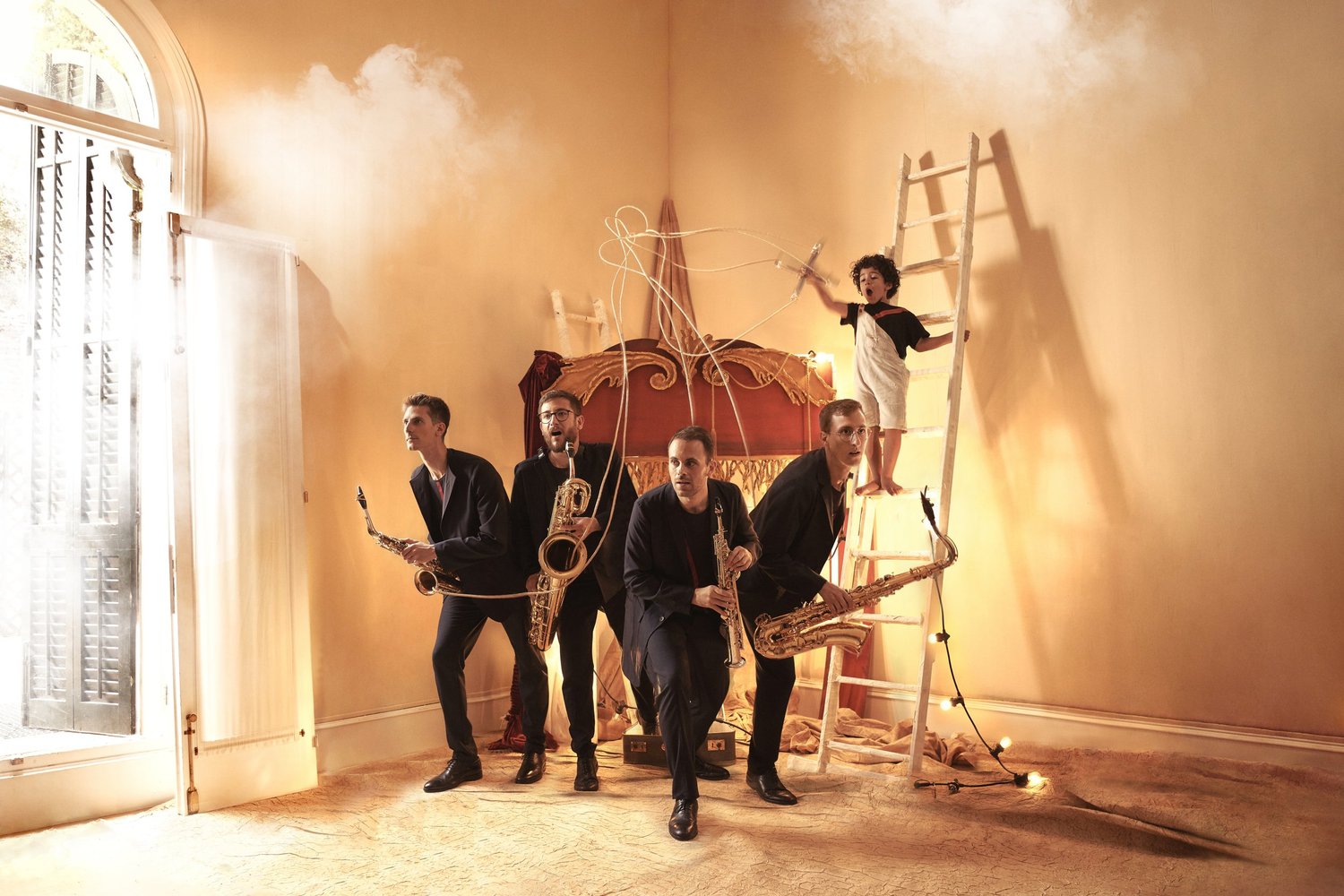

Founded in Barcelona in 2014, the Kebyart Saxophone Quartet has rapidly become one of the most distinctive ensembles in contemporary chamber music. While the saxophone has a comparatively short chamber-music history, the ensemble has embraced it for both the creation of new works and the imaginative re-thinking of music from earlier centuries. Their programmes frequently combine contemporary works written specifically for them with arrangements that reveal unexpected colours in familiar repertoire.
The quartet has been praised for their ‘synchronization, interpretative strength, and musical communication’ (Catalan Music Magazine), while a recent concert at the Barbican was noted for offering ‘a fresh perspective on traditional classical performance’.
Today they present their exciting programme punto di fuga which they describe as follows:
‘The punto di fuga is where lines converge in pictorial art, the point on the horizon where all perspectives meet. In the same way, the program presents pieces that include fugues and, despite being from different periods, ultimately find common ground on the horizon.
Two fugues in C minor open each of the two halves: Bach and Mozart. Bach’s Passacaglia und Fuge connects directly with César Franck, who, in his original organ work, draws on Bachian models. Widmann engages with historical forms such as chorales, like Bach, and waltzes, while simultaneously expanding the sound world through noise effects, unconventional key techniques, and the humorous Zirkusparade.
For the second half, Mozart’s C minor Adagio und Fuge links directly to Haas’s quartet, which in a way functions as a total vanishing point, where continuous lines intertwine until they meet in an apotheotic ending. Finally, Ligeti’s Bagatellen, besides including many small fugues in their movements (motifs that respond to and pass from one voice to another), also act as a punto di fuga, as each piece adds new notes in a journey toward the tonal horizon.’
Pere Méndez – (Soprano Saxophone), Víctor Serra (Alto Saxophone), Robert Seara (Tenor Saxophone), Daniel Miguel (Baritone Saxophone)
Photo: © Kebyart